July 8, 2025
Choosing the Unknown - Chapter One

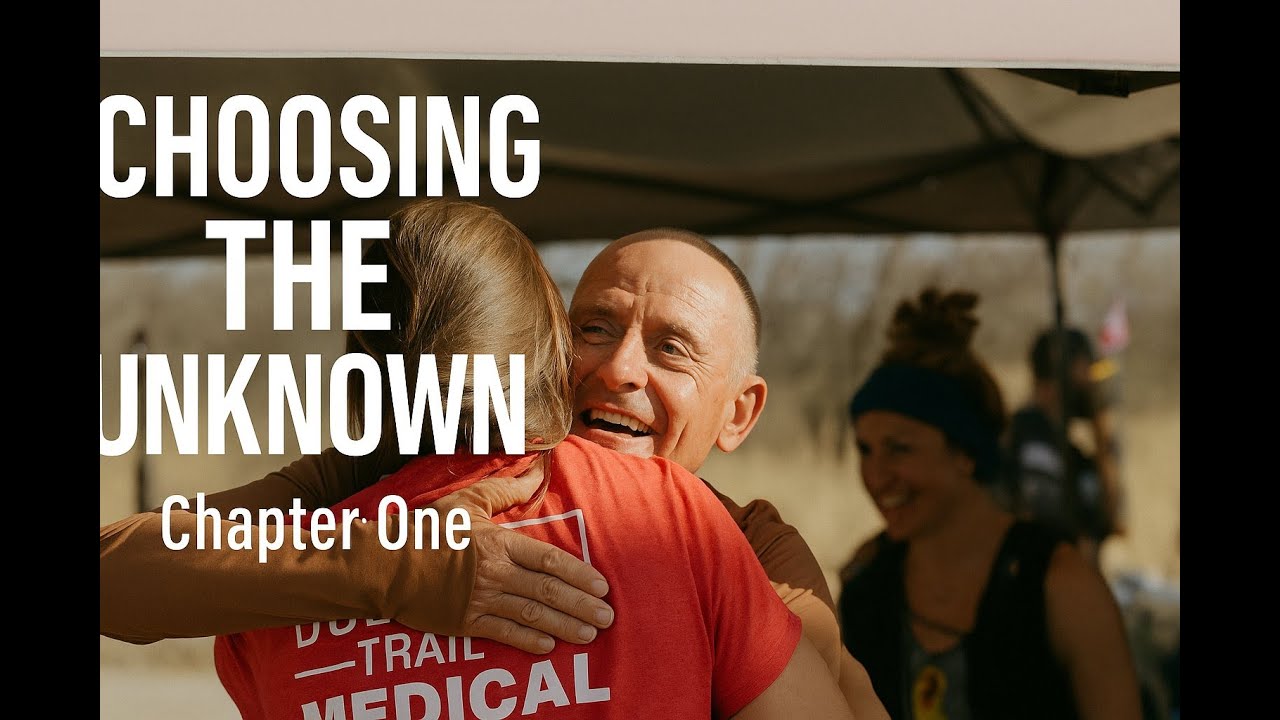

What happens when you step into the unknown—even when everything is going wrong?
In Chapter One of our Choosing the Unknown series, host Paul Johnson stands at the starting line of the Cocodona 250, but the real story begins long before the race starts. Three weeks earlier, he pushed through the Arizona Monster 300, battling the desert, fatigue, and self-doubt. This episode explores what drives us to step into the unknown, even when everything is already going wrong, and what it means to keep going when it would be easier to stop. It's a story of fear, humor, endurance, and the quiet moments that define us.
1
00:00:00,000 --> 00:00:05,000
Chapter One
2
00:00:05,000 --> 00:00:10,000
[00:00:00]
3
00:00:10,000 --> 00:00:15,000
Paul Johnson: He became the glute whisperer. He laid me on my stomach in the crew vehicle. Found the glute, found the knot. Dug in with a lacrosse ball. The pain was intense. He worked the muscle like he was trying to find a confession. I squirmed groaned, but when I left that aid station, I was standing a little straighter.
4
00:00:15,000 --> 00:00:20,000
Paul Johnson: I'm your host, Paul Johnson, and this is Get Some, a podcast of stories about who we are, how we struggle, and why we keep going. This special series is devoted to Cocodona. Sometimes the unknown shows up like a detox center in the desert. Greg who we met in the prologue [00:01:00] didn't know what he was saying yes to that morning, but he said it anyway.
5
00:00:20,000 --> 00:00:25,000
And now. He's building a new life in Prescott, a clean life and sending quiet messages that simply say, still here. That's what the unknown can look like. Not a finish line, just a doorway someone holds open and the decision to walk through it. And sometimes it looks like this. 5:00 AM Black Canyon City, the start of a 250 mile foot race through Arizona.
6
00:00:25,000 --> 00:00:30,000
A race called Cocodona. I had just finished the Arizona Monster 300 miles. Three weeks earlier, somewhere around mile 100. The runner's lean came for me. But this time, I had help a glute, a lacrosse ball, and a pacer who wasn't afraid to dig. [00:02:00] And by the end, I was standing tall. Still, Cocodona was no sure thing. Five days before the start, my heel lit up sharp, sudden, the kind of pain that makes you wonder if it's even worth trying, but I was already signed up already chasing something bigger, the Cocodona 1000 mile buckle. So I showed up. No guarantees, no excuses. Just one more unknown to step into. This is chapter one, the starting line isn't always the start because before we talk about Cocodona, we have to talk about Arizona Monster.
7
00:00:30,000 --> 00:00:35,000
Paul Johnson: It's Ultra. Get Some chapter one. The starting line isn't always the start. Most stories don't start with everything going [00:03:00] right. Okay, so to begin, we're going to talk about everything that was already going wrong before the race even began. I think that's enough setup for now. Let me tell you what happened.
8
00:00:35,000 --> 00:00:40,000
Just three weeks before I stood at the start line of Cocodona 250, I finished the longest race of my life, 300 miles, Arizona Monster. And if you're thinking, wait, people run 300 miles. Yeah, it's a thing. If you've never heard of races like that, no surprise, most people haven't. Most people have heard of a marathon 26.2 miles.
9
00:00:40,000 --> 00:00:45,000
Now imagine running 10 marathons back to back with little sleep through mountains, deserts, and forests. That's what races like Cocodona [00:04:00] and the Arizona Monster are 200 plus mile foot races that can take four to six days to finish. They're called ultra marathons. Runners move through the day and night, stopping only briefly to rest and eat.
10
00:00:45,000 --> 00:00:50,000
There are aid stations, but you carry what you need, manage your feet, your food, your mental state. It's part race, part survival, part journey. It's extreme. It's strange, and somehow it's also kind of beautiful. Honestly, it's hard to explain to anyone who hasn't done one. Anyway, I did the Arizona Monster, and then three weeks later I did the Cocodona 250. Somewhere around Mile 100 at the Arizona Monster. I started to feel it again, a subtle tilt. I mentioned it to a [00:05:00] fellow runner. She nodded. Yeah, she said, you're starting to lean At the next checkpoint her crew chief confirmed it to me. Paul, you know, you're leaning right, not collapsed, just noticeable the beginning of something. This wasn't my first encounter.
11
00:00:50,000 --> 00:00:55,000
My first was during a 100 miler, then again at the inaugural Cocodona 250 in 2021. That one ended my race. I couldn't move fast enough because I couldn't stand up straight. I didn't finish. So when the lean started creeping in again at the Arizona Monster, I knew exactly what I was up against But this time. I wasn't just hoping it would go away. I had read about someone who faced the same thing and found a way through it. His name is Wes [00:06:00] Ritner. If you've spent any time at the front of a long race, you know there's a different energy there. It's not loud, it's not chaotic, it's quiet, focused, intentional.
12
00:00:55,000 --> 00:01:00,000
That's where you'll find Wes Ritner, fair skinned light, brown hair, the calm look of someone who's been through it before and knows how to handle himself out there. He's lean, but not brittle. Built like a long distance machine. Tuned over time. Every stride looks like it belongs to someone who understands exactly how much effort it takes to win and how much to hold back.
13
00:01:00,000 --> 00:01:05,000
He moves with purpose, not like he's trying to impress anyone, but like he's been here before. Because he has, For Wes, there's no wasted motion, no unnecessary gear. [00:07:00] Everything has a purpose, including his smile, small, calm. The kind you wear when you know you're where you're supposed to be In the background, mountains, heat distance.
14
00:01:05,000 --> 00:01:10,000
But up front there's Wes moving forward, not chasing anything, just leading quietly. And his story stayed with me because what happened to him at the 2024 Moab 240 was almost exactly what was happening to me at the Arizona Monster. Wes Ritner is a retired army officer, Wes Point grad, former tank commander, who now lives in the foothills of the Colorado Rockies In the ultra running world. he's something of a fixture, quiet, disciplined, 17 finishes in 200 mile races, seven at Moab, But in 2022, Moab nearly broke him. [00:08:00] Not the terrain, not the distance. Something less obvious. A creeping tightness in his back, starting on one side, then spreading. Eventually his entire body began to lean. He couldn't run more than a few steps without pain.
15
00:01:10,000 --> 00:01:15,000
He hobbled to the finish bent like a tree in the wind. It's called runner's lean, and no one really knows how to fix it. After 2022 Wes started digging through forums, blogs, anything he could find. Most of it was vague. Talk about potassium or strength electrolytes, but none of it helped except for one article.
16
00:01:15,000 --> 00:01:20,000
It described a technique by a Hungarian born osteopathic physician, an ultra runner named Dr. Andrew Lovy. A kind of reset for the gluteus minimus, the muscle deep inside the [00:09:00] hip that according to Dr. Lovy, is where the lean begins. So in 2024, when the first signs came on, just after Shay Mountain at the Moab 240, Wes didn't wait.
17
00:01:20,000 --> 00:01:25,000
He stopped right there on the side of the trail, found a half buried boulder, and used it. Awkwardly creatively to apply pressure to his glute. Five minutes he stood up, the tightness was gone and it never came back. Later he would write, the tightness in my back had vanished and it never returned at any time. during the race Wes didn't just salvage his race. He ran Moab strong, upright, all the way to the finish. And when I read that story, what he did, how he figured it out, I knew it might matter for me too. [00:10:00] Dr. Andrew Lovy has run nearly 200 marathons and more than 230 ultra marathons. He saw a pattern. He believed the problem was neurological buried inside the gluteus minimus, that small muscle on the side of the hip.
18
00:01:25,000 --> 00:01:30,000
He first noticed it years ago at a race in France. A runner named Roy Pirrung started leaning. Lovy tried everything. It helped briefly, but the lean returned, so Lovy went deep studying gait, mechanics, muscle fatigue, biomechanics. Eventually he found a technique that helped meet the problem and reset the problem.
19
00:01:30,000 --> 00:01:35,000
He tried it on runners at 24 and 48 hour races. It worked. He taught the method to medical students, His theory. Some muscles run out of potassium mid-race. They stop firing [00:11:00] The opposite muscles. keep going. You lean toward what stopped working. Adding potassium doesn't help. The sequence has to be reset.
20
00:01:35,000 --> 00:01:40,000
That's what his technique does. Deep manual pressure to the gluteus minimus, hold it, let it release. Then a stretch. He says within a half mile the lean stops. Sometimes it comes back. If it does, we repeat. That's the Lovy technique and at mile 100, I wasn't just willing to try it. I was counting on it. By the way, Dr. Lovy is 90 years old and still moving. He lives in Houston and continues to inspire In his words. only God knows how long you will live. you choose how to live. Enter Jonathan Pantele, my pacer, my crew. He's [00:12:00] six feet tall, athletic, broad shouldered, a neatly kept beard, kind, eyes, A musician with a baritone voice.
21
00:01:40,000 --> 00:01:45,000
Runners once called him the singing pacer. Jonathan didn't go to college, but he trained hands-on with a physical therapist and he has a gift At this race. he became the glute whisperer. He laid me on my stomach in the crew vehicle. Found the glute, found the knot. Dug in with a lacrosse ball.
22
00:01:45,000 --> 00:01:50,000
Paul Johnson: The pain was intense.
23
00:01:50,000 --> 00:01:55,000
He worked the muscle like he was trying to find a confession. [00:13:00] I squirmed groaned but when I left that aid station, I was standing a little straighter. Massage gun was tucked in the back of my running vest with instructions to use it on myself if things went sideways. As I was leaving my crew chief asked, Think it'll work, Jonathan. It'll take a miracle At every checkpoint, Jonathan repeated the process, the pain, the brief relief. The lean always crept back Between checkpoints. trail therapy was essential. I lay on the ground, face down my pacer, knelt beside me driving the massage gun into the same stubborn knot. Not exactly a proud moment, but when you're trying to make it 300 miles, dignity is optional.
24
00:01:55,000 --> 00:02:00,000
Runners passed by visibly confused, but too polite to say anything because let's be honest, [00:14:00] nobody does this. Somewhere after mile 300, The need for massages started to fade. I was running tall again, shoulders level, posture, straight. It felt miraculous. Apparently the Lovy technique worked. Maybe the muscle gave up.
25
00:02:00,000 --> 00:02:05,000
Maybe Jonathan scared it straight, but we finished all 300 miles of Arizona Monster. And three weeks later, Cocodona, I knew the risk. Most people don't run a 250 mile race three weeks after a 300, but I was chasing something bigger. The Cocodona 1000 mile belt buckle four finishes, only a few people had earned it. The lean was still fresh in my mind.
26
00:02:05,000 --> 00:02:10,000
Just three weeks earlier at the Arizona Monster. It had nearly taken me out, [00:15:00] so yeah, I was aware it could come back. But five days before Cocodona started a new problem showed up. My right heel lit up, sudden sharp, not sore, lit up. Like there was a spike in my shoe, worse in the morning, lingering all day. The diagnosis probably plantar fasciitis, a nasty inflammation in the bottom of the foot that makes every step feel like punishment because apparently one issue wasn't enough cause unknown.
27
00:02:10,000 --> 00:02:15,000
I didn't do much trail running between races. No altitude training, no long climbs. Just 50 hours of pickleball because nothing says ready for a mountain. ultra like a wiffle ball and a doubles [00:16:00] match. It's race. morning Cocodona. I'm in Black Canyon City, Arizona. My crew is here. Christopher Johnson.
28
00:02:15,000 --> 00:02:20,000
Jeffrey Johnson. Jonathan Pantele and Liam Rogers. The gear's ready. The crew is dialed in. We're at the start of something big, a 250 mile adventure through the mountains and deserts of Arizona. Now it's just me and whatever's waiting out there. Ten nine. My heel, it hurts five. four. I think about the lean, the knot and whether Jonathan remembers where he packed the lacrosse ball.
29
00:02:20,000 --> 00:02:25,000
Three, two.
30
00:02:25,000 --> 00:02:30,000
I step forward and Cocodona begins.
31
00:02:30,000 --> 00:02:35,000
We plan, we [00:17:00] prepare, we study every mile pack, every drop, bag, chart, every calorie, and still we toe the line knowing full well that something will go wrong. Maybe something small, maybe something that breaks us From the outside. It looks like chaos. From the inside it's control until it isn't. We choose the unknown anyway, because sometimes the only way forward is to move forward.
32
00:02:35,000 --> 00:02:40,000
Paul Johnson: Next time on Get Some, we leave the Arizona Monster behind. And step onto a battered old mining road in the Bradshaw Mountains. The clouds are low, the trail is wet, and Cocodona is just getting started. Just a few hours into the race. On the very first morning, I hear footsteps [00:18:00] behind me on the climb through the Bradshaw Mountains.
33
00:02:40,000 --> 00:02:45,000
It's Andy Jones Wilkins, a name I've known for years. He's here in the same moment, moving steady. One of ultra running's most respected voices, 10 time Western States finisher, a guy who's taught a generation of runners, what it means to go long, and now two runners on the same climb in very different places.
34
00:02:45,000 --> 00:02:50,000
Chapter two, the veteran. What happens when expertise meets uncertainty? That's next week on Get Some.
35
00:02:50,000 --> 00:02:55,000
This episode was reported, written, and produced by me, Paul Johnson. Field support and sharp trail insight from my crew, Christopher Johnson, Jeffrey Johnson, Jonathan Pantele, and Liam Rogers. If this story [00:19:00] meant something to you, share Get Some with someone who shows up even when the outcome is unclear. Thanks for listening.
36
00:02:55,000 --> 00:03:00,000
I'll see you in the next episode.
00:00:00,000 --> 00:00:05,000
Chapter One
2
00:00:05,000 --> 00:00:10,000
[00:00:00]
3
00:00:10,000 --> 00:00:15,000
Paul Johnson: He became the glute whisperer. He laid me on my stomach in the crew vehicle. Found the glute, found the knot. Dug in with a lacrosse ball. The pain was intense. He worked the muscle like he was trying to find a confession. I squirmed groaned, but when I left that aid station, I was standing a little straighter.
4
00:00:15,000 --> 00:00:20,000
Paul Johnson: I'm your host, Paul Johnson, and this is Get Some, a podcast of stories about who we are, how we struggle, and why we keep going. This special series is devoted to Cocodona. Sometimes the unknown shows up like a detox center in the desert. Greg who we met in the prologue [00:01:00] didn't know what he was saying yes to that morning, but he said it anyway.
5
00:00:20,000 --> 00:00:25,000
And now. He's building a new life in Prescott, a clean life and sending quiet messages that simply say, still here. That's what the unknown can look like. Not a finish line, just a doorway someone holds open and the decision to walk through it. And sometimes it looks like this. 5:00 AM Black Canyon City, the start of a 250 mile foot race through Arizona.
6
00:00:25,000 --> 00:00:30,000
A race called Cocodona. I had just finished the Arizona Monster 300 miles. Three weeks earlier, somewhere around mile 100. The runner's lean came for me. But this time, I had help a glute, a lacrosse ball, and a pacer who wasn't afraid to dig. [00:02:00] And by the end, I was standing tall. Still, Cocodona was no sure thing. Five days before the start, my heel lit up sharp, sudden, the kind of pain that makes you wonder if it's even worth trying, but I was already signed up already chasing something bigger, the Cocodona 1000 mile buckle. So I showed up. No guarantees, no excuses. Just one more unknown to step into. This is chapter one, the starting line isn't always the start because before we talk about Cocodona, we have to talk about Arizona Monster.
7
00:00:30,000 --> 00:00:35,000
Paul Johnson: It's Ultra. Get Some chapter one. The starting line isn't always the start. Most stories don't start with everything going [00:03:00] right. Okay, so to begin, we're going to talk about everything that was already going wrong before the race even began. I think that's enough setup for now. Let me tell you what happened.
8
00:00:35,000 --> 00:00:40,000
Just three weeks before I stood at the start line of Cocodona 250, I finished the longest race of my life, 300 miles, Arizona Monster. And if you're thinking, wait, people run 300 miles. Yeah, it's a thing. If you've never heard of races like that, no surprise, most people haven't. Most people have heard of a marathon 26.2 miles.
9
00:00:40,000 --> 00:00:45,000
Now imagine running 10 marathons back to back with little sleep through mountains, deserts, and forests. That's what races like Cocodona [00:04:00] and the Arizona Monster are 200 plus mile foot races that can take four to six days to finish. They're called ultra marathons. Runners move through the day and night, stopping only briefly to rest and eat.
10
00:00:45,000 --> 00:00:50,000
There are aid stations, but you carry what you need, manage your feet, your food, your mental state. It's part race, part survival, part journey. It's extreme. It's strange, and somehow it's also kind of beautiful. Honestly, it's hard to explain to anyone who hasn't done one. Anyway, I did the Arizona Monster, and then three weeks later I did the Cocodona 250. Somewhere around Mile 100 at the Arizona Monster. I started to feel it again, a subtle tilt. I mentioned it to a [00:05:00] fellow runner. She nodded. Yeah, she said, you're starting to lean At the next checkpoint her crew chief confirmed it to me. Paul, you know, you're leaning right, not collapsed, just noticeable the beginning of something. This wasn't my first encounter.
11
00:00:50,000 --> 00:00:55,000
My first was during a 100 miler, then again at the inaugural Cocodona 250 in 2021. That one ended my race. I couldn't move fast enough because I couldn't stand up straight. I didn't finish. So when the lean started creeping in again at the Arizona Monster, I knew exactly what I was up against But this time. I wasn't just hoping it would go away. I had read about someone who faced the same thing and found a way through it. His name is Wes [00:06:00] Ritner. If you've spent any time at the front of a long race, you know there's a different energy there. It's not loud, it's not chaotic, it's quiet, focused, intentional.
12
00:00:55,000 --> 00:01:00,000
That's where you'll find Wes Ritner, fair skinned light, brown hair, the calm look of someone who's been through it before and knows how to handle himself out there. He's lean, but not brittle. Built like a long distance machine. Tuned over time. Every stride looks like it belongs to someone who understands exactly how much effort it takes to win and how much to hold back.
13
00:01:00,000 --> 00:01:05,000
He moves with purpose, not like he's trying to impress anyone, but like he's been here before. Because he has, For Wes, there's no wasted motion, no unnecessary gear. [00:07:00] Everything has a purpose, including his smile, small, calm. The kind you wear when you know you're where you're supposed to be In the background, mountains, heat distance.
14
00:01:05,000 --> 00:01:10,000
But up front there's Wes moving forward, not chasing anything, just leading quietly. And his story stayed with me because what happened to him at the 2024 Moab 240 was almost exactly what was happening to me at the Arizona Monster. Wes Ritner is a retired army officer, Wes Point grad, former tank commander, who now lives in the foothills of the Colorado Rockies In the ultra running world. he's something of a fixture, quiet, disciplined, 17 finishes in 200 mile races, seven at Moab, But in 2022, Moab nearly broke him. [00:08:00] Not the terrain, not the distance. Something less obvious. A creeping tightness in his back, starting on one side, then spreading. Eventually his entire body began to lean. He couldn't run more than a few steps without pain.
15
00:01:10,000 --> 00:01:15,000
He hobbled to the finish bent like a tree in the wind. It's called runner's lean, and no one really knows how to fix it. After 2022 Wes started digging through forums, blogs, anything he could find. Most of it was vague. Talk about potassium or strength electrolytes, but none of it helped except for one article.
16
00:01:15,000 --> 00:01:20,000
It described a technique by a Hungarian born osteopathic physician, an ultra runner named Dr. Andrew Lovy. A kind of reset for the gluteus minimus, the muscle deep inside the [00:09:00] hip that according to Dr. Lovy, is where the lean begins. So in 2024, when the first signs came on, just after Shay Mountain at the Moab 240, Wes didn't wait.
17
00:01:20,000 --> 00:01:25,000
He stopped right there on the side of the trail, found a half buried boulder, and used it. Awkwardly creatively to apply pressure to his glute. Five minutes he stood up, the tightness was gone and it never came back. Later he would write, the tightness in my back had vanished and it never returned at any time. during the race Wes didn't just salvage his race. He ran Moab strong, upright, all the way to the finish. And when I read that story, what he did, how he figured it out, I knew it might matter for me too. [00:10:00] Dr. Andrew Lovy has run nearly 200 marathons and more than 230 ultra marathons. He saw a pattern. He believed the problem was neurological buried inside the gluteus minimus, that small muscle on the side of the hip.
18
00:01:25,000 --> 00:01:30,000
He first noticed it years ago at a race in France. A runner named Roy Pirrung started leaning. Lovy tried everything. It helped briefly, but the lean returned, so Lovy went deep studying gait, mechanics, muscle fatigue, biomechanics. Eventually he found a technique that helped meet the problem and reset the problem.
19
00:01:30,000 --> 00:01:35,000
He tried it on runners at 24 and 48 hour races. It worked. He taught the method to medical students, His theory. Some muscles run out of potassium mid-race. They stop firing [00:11:00] The opposite muscles. keep going. You lean toward what stopped working. Adding potassium doesn't help. The sequence has to be reset.
20
00:01:35,000 --> 00:01:40,000
That's what his technique does. Deep manual pressure to the gluteus minimus, hold it, let it release. Then a stretch. He says within a half mile the lean stops. Sometimes it comes back. If it does, we repeat. That's the Lovy technique and at mile 100, I wasn't just willing to try it. I was counting on it. By the way, Dr. Lovy is 90 years old and still moving. He lives in Houston and continues to inspire In his words. only God knows how long you will live. you choose how to live. Enter Jonathan Pantele, my pacer, my crew. He's [00:12:00] six feet tall, athletic, broad shouldered, a neatly kept beard, kind, eyes, A musician with a baritone voice.
21
00:01:40,000 --> 00:01:45,000
Runners once called him the singing pacer. Jonathan didn't go to college, but he trained hands-on with a physical therapist and he has a gift At this race. he became the glute whisperer. He laid me on my stomach in the crew vehicle. Found the glute, found the knot. Dug in with a lacrosse ball.
22
00:01:45,000 --> 00:01:50,000
Paul Johnson: The pain was intense.
23
00:01:50,000 --> 00:01:55,000
He worked the muscle like he was trying to find a confession. [00:13:00] I squirmed groaned but when I left that aid station, I was standing a little straighter. Massage gun was tucked in the back of my running vest with instructions to use it on myself if things went sideways. As I was leaving my crew chief asked, Think it'll work, Jonathan. It'll take a miracle At every checkpoint, Jonathan repeated the process, the pain, the brief relief. The lean always crept back Between checkpoints. trail therapy was essential. I lay on the ground, face down my pacer, knelt beside me driving the massage gun into the same stubborn knot. Not exactly a proud moment, but when you're trying to make it 300 miles, dignity is optional.
24
00:01:55,000 --> 00:02:00,000
Runners passed by visibly confused, but too polite to say anything because let's be honest, [00:14:00] nobody does this. Somewhere after mile 300, The need for massages started to fade. I was running tall again, shoulders level, posture, straight. It felt miraculous. Apparently the Lovy technique worked. Maybe the muscle gave up.
25
00:02:00,000 --> 00:02:05,000
Maybe Jonathan scared it straight, but we finished all 300 miles of Arizona Monster. And three weeks later, Cocodona, I knew the risk. Most people don't run a 250 mile race three weeks after a 300, but I was chasing something bigger. The Cocodona 1000 mile belt buckle four finishes, only a few people had earned it. The lean was still fresh in my mind.
26
00:02:05,000 --> 00:02:10,000
Just three weeks earlier at the Arizona Monster. It had nearly taken me out, [00:15:00] so yeah, I was aware it could come back. But five days before Cocodona started a new problem showed up. My right heel lit up, sudden sharp, not sore, lit up. Like there was a spike in my shoe, worse in the morning, lingering all day. The diagnosis probably plantar fasciitis, a nasty inflammation in the bottom of the foot that makes every step feel like punishment because apparently one issue wasn't enough cause unknown.
27
00:02:10,000 --> 00:02:15,000
I didn't do much trail running between races. No altitude training, no long climbs. Just 50 hours of pickleball because nothing says ready for a mountain. ultra like a wiffle ball and a doubles [00:16:00] match. It's race. morning Cocodona. I'm in Black Canyon City, Arizona. My crew is here. Christopher Johnson.
28
00:02:15,000 --> 00:02:20,000
Jeffrey Johnson. Jonathan Pantele and Liam Rogers. The gear's ready. The crew is dialed in. We're at the start of something big, a 250 mile adventure through the mountains and deserts of Arizona. Now it's just me and whatever's waiting out there. Ten nine. My heel, it hurts five. four. I think about the lean, the knot and whether Jonathan remembers where he packed the lacrosse ball.
29
00:02:20,000 --> 00:02:25,000
Three, two.
30
00:02:25,000 --> 00:02:30,000
I step forward and Cocodona begins.
31
00:02:30,000 --> 00:02:35,000
We plan, we [00:17:00] prepare, we study every mile pack, every drop, bag, chart, every calorie, and still we toe the line knowing full well that something will go wrong. Maybe something small, maybe something that breaks us From the outside. It looks like chaos. From the inside it's control until it isn't. We choose the unknown anyway, because sometimes the only way forward is to move forward.
32
00:02:35,000 --> 00:02:40,000
Paul Johnson: Next time on Get Some, we leave the Arizona Monster behind. And step onto a battered old mining road in the Bradshaw Mountains. The clouds are low, the trail is wet, and Cocodona is just getting started. Just a few hours into the race. On the very first morning, I hear footsteps [00:18:00] behind me on the climb through the Bradshaw Mountains.
33
00:02:40,000 --> 00:02:45,000
It's Andy Jones Wilkins, a name I've known for years. He's here in the same moment, moving steady. One of ultra running's most respected voices, 10 time Western States finisher, a guy who's taught a generation of runners, what it means to go long, and now two runners on the same climb in very different places.
34
00:02:45,000 --> 00:02:50,000
Chapter two, the veteran. What happens when expertise meets uncertainty? That's next week on Get Some.
35
00:02:50,000 --> 00:02:55,000
This episode was reported, written, and produced by me, Paul Johnson. Field support and sharp trail insight from my crew, Christopher Johnson, Jeffrey Johnson, Jonathan Pantele, and Liam Rogers. If this story [00:19:00] meant something to you, share Get Some with someone who shows up even when the outcome is unclear. Thanks for listening.
36
00:02:55,000 --> 00:03:00,000
I'll see you in the next episode.
